Posted in Blog Posts, Television

Television Tuesdays: Preacher

Overview

Based on a graphic novel, Preacher is about a West Texas preacher who gains a celestial power, then goes on a quest for God. It’s about more than that, of course. It’s about faith, and relationships, and how brutal humanity can be. It’s about redemption, and betrayal. It’s an interesting portrait of the lengths people will go to in order to believe in a higher power, the faith they put in a man of god, and how that belief can be swayed.

Of course, that’s all putting things way too simply. The show is violent, and takes glee in enacting that violence (at one point, a character’s arm is cut off by a chainsaw, and then the chainsaw drags the dismembered arm down the aisle of a church). I would argue, though, that it’s done well. That the imagination and cleverness that goes into those acts of aggression make it something more than senseless. The audience doesn’t always know why it’s happening, but it feels appropriate. Despite the show taking almost until the end of the first season (which just ended) to get to the real thesis of the show, it’s well worth the wild ride.

It was my favorite show this summer, hitting all of the check boxes that turn shows into my favorite: attractive men (Dominic Cooper wearing all black with a Southern accent 🔥🔥🔥) , mythology, violence, kick-ass women, and interesting conflict. The show also has some of the best cinematography I’ve seen in either movies or television. It’s absolutely stunning. I’m not entirely sure how to write about Preacher without spoiling everything or doing it a disservice. There’s no way I’ll manage to tell you everything about it, but I hope this is enough to encourage you to give it a try.

Characters

tumblr_inline_o8scwj2e5R1qgp297_500

Jesse Custer (Dominic Cooper) is the titular preacher. He inherited his small church from his late father and feels compelled to act as a shepherd of god because, as a child, he witnessed his father’s murder and it was his father’s last wish that Jesse “be good.” Based on flashbacks and allusions, we can gather that Jesse hasn’t always been a good person. Hell, he isn’t for most of the show. Instead, he’s conflicted, and power-mad, and wanting. When Jesse gains the power of Genesis, which allows him to command any living thing to follow his will, he abuses it. He plays god and people get hurt, some vindictively. He relishes the power and refuses to relinquish it, not until his sins are erased and he has spoken to God. When he tries, things don’t quite go according to plan.

Tulip O’Hare (Ruth Negga) is Jesse’s ex-girlfriend who’s on a quest for revenge. She bursts back into town in attempts to win Jesse back and have him join her as she sets out to ruin the man who wronged them both. Sharp and violent, Tulip refuses to put up with anyone’s shit. She’s proud, commanding, and unapologetic. Like Jesse, she’s not a good person, but that underlying frisson of danger keeps her getting out of bed in the morning. She’s captivating.
CteuVk6

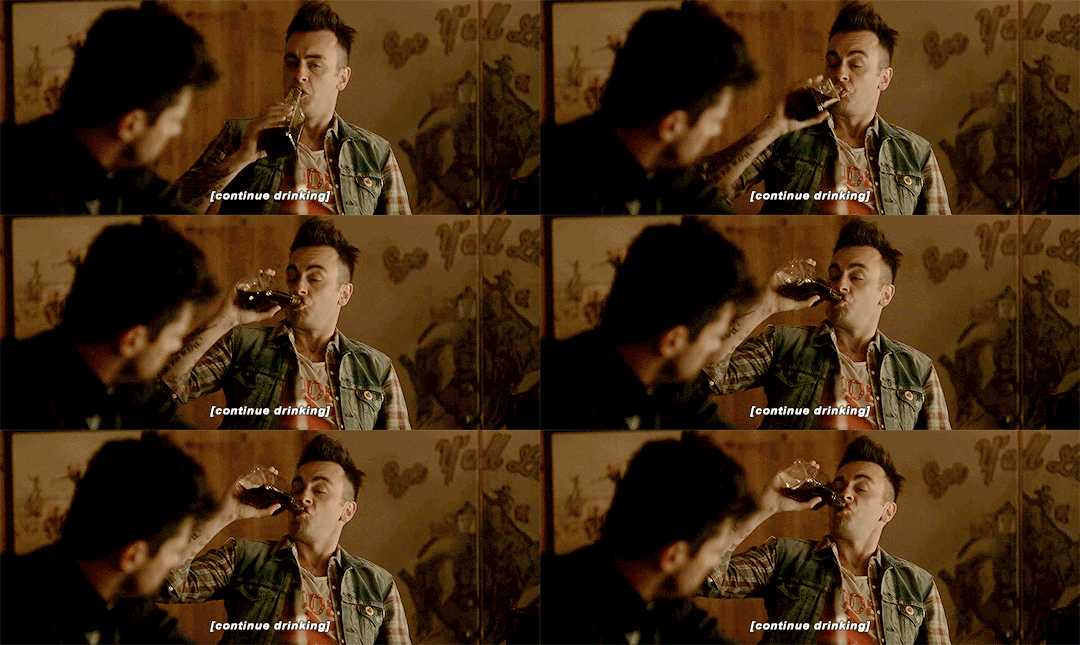
Cassidy (Joseph Gilgun) is an Irish vampire. Yup, cue the absurdist. However, unless he is actively pursuing some vampiric behavior (such as using a broken champagne bottle as a tap to turn a man into a blood dispenser), it’s easy to forget that particular trait of his. It’s much easier, in fact, to remember his disdain for The Big Lebowski. He is Jesse’s best friend and a wonderful foil – Cassidy, more than anyone else, is the one to challenge Jesse’s humanity and the rationale behind his actions.

Mythology

tumblr_o921rqLDxq1uuucb7o1_540

Aside from Cassidy’s vampirism, the show delves close to Supernatural territory with some of its mythology. Genesis, the aforementioned power that inhabits Jesse, is a power created by the coupling of an angel and a demon. It’s storied to be a power that rivals only that of God. Early in the show, we see Genesis try and inhabit bodies other than Jesse’s but they can’t handle it. We don’t know why Jesse is an appropriate vessel for Genesis yet, but I’m excited to find out.

Jesse is not supposed to have Genesis’ power, so missionaries from Heaven, the guardians of Genesis, seek it out so that they may return it safely to its vessel. The vessel isn’t anything exciting, only an old coffee can, and its lured out of Jesse with song. I’m still not entirely clear as to why.

The two men pictured above, Fiore and DeBlanc, are Heaven’s missionaries. They seek Jesse out and do everything in their power to return Genesis to its rightful vessel. Their antagonist is a soccer mom-looking woman, a seraphim (powerful angel) whose job is to return the two angels from their unauthorized visit Earth-side. There’s a lot to unpack, and at points in the show it’s unclear exactly what’s going on, but it’s a hell of a ride.

Posted in Television

Television Tuesdays: Great British Baking Show

Overview

You may know it as The Great British Bake-Off, but either way, this show is sheer perfection. Twelve contestants are assembled and each week, one is crowned Star Baker, and one is sent home. There is currently three seasons available on Netflix. Each summer, PBS airs a new (to America) season.

Set-Up

Each episode has a theme: pastries, pies, cakes, biscuits, etc. And then, according to the theme, the bakers are given three distinct challenges: the Signature Bake, the Technical Challenge, and the Showstopper. The rounds are all judged by Mary Barry (cook book writer and a delight) and Paul Hollywood (less shout-y, bread obsessed Gordon Ramsey).

First up is the signature bake, in which each contestant must make their own version of the week’s theme. This challenge is to show off their taste and style.

In the technical, all of the contestants are given the same bare-bones recipes and instructed to make identical bakes. Usually, none of the contestants have ever made whatever they’re being challenged to bake in this round. Their bakes are all judged blindly by Paul and Mary, and then ranked from worst to best.

The showstopper is exactly what it sounds like, the contestants have to make something really cool, and usually some kind of baked structure.

tumblr_nurxbxuceu1s5v14qo1_500

The Hook

I can hear you sitting there, asking what the appeal of this show is. What differentiates it between any other cooking show on TV? Unlike most reality competition shows, this show doesn’t foster rivalry and hostility, but that doesn’t mean there’s no tension. I have gasped, cried, yelled, and laughed in the course of watching this show. Probably over the course of a single episode. There is no greater drama than that of a cake dropping onto the floor.

I think the show’s real power is in its editing. Viewers are given enough time with the contestants to learn their personalities without having to know their whole life story. It’s easy to pick favorites, and nice to have someone to cheer for. It feels rewarding when we see quiet moments of contestants rushing to help each other when they have a moment to spare or one is in dire need of assistance. Occasionally one of the hosts (British comedy duo Mel & Sue) will accidentally ruin a contestant’s bake by eating some of their ingredients. The time we spend with the judges and hosts is relatively minimal, and the interspersal of gorgeous shots of baked goods sure does help. In the end, the show has high tension with relatively low stakes and the camaraderie makes it more soothing to watch than most other competition shows. Great British Baking Show is the perfect show to watch after a bad day or when you’re in need of a break from reality.

Posted in Television

Television Tuesdays: Jane the Virgin

cw-shows-renewed-jane-the-virgin

Overview

Based on a Venezuelan telenovela, Jane the Virgin is a soapy delight that just wrapped its second season on The CW. The show follows Jane Villanueva, a 21 year old college student from Miami, Florida who goes in to her OB/GYN’s office for a regular pap smear and ends up accidentally artificially inseminated.

I know.

I will never walk into my gyno’s office without thinking of this show, ever again. At first, Jane is panicked and unsure as to whether she wants to pursue this surprise pregnancy – she’s newly engaged to the love of her life, Michael, and from a very devout Catholic family. But after it’s revealed that the father, Rafael, had cancer and this is his only shot at biological children, Jane reconsiders. The first season follows her pregnancy, while the second explores new motherhood.

I never thought I would be interested in a show about a new mom, her baby, and her very close family (Jane lives with her mother and grandmother), yet here I am. It’s a testament to how strong those relationships are, how thoughtfully they are crafted, and how interesting their dynamics can be, that keep me tuning in.

 Relationships

The heart of this show is about relationships in all their varying forms. Jane is clearly at the center, but the show deftly explores each connection that she has (with the exception of her best friend, played by Orange Is The New Black actress, Diane Guerrero).

Jane and her mother Xiomara live with the matriarch of the Villanueva family, Alba. Jane, while at times fanciful, tends to be the reserved, sensible counterweight to her mother, while Alba doles out wisdom and unconditional love (and the occasional hand-upside-the-head). As a show with four generations living in one house, mother-child relationships are of course explored, and I think the play between Jane-Xiomara, Jane-Alba, Xiomara-Alba, offers such a rich puzzle of opinions and concerns. One of the most beautiful things about this show is also the way it explores language between different generations. Alba, an immigrant from Venezuela, exclusively speaks Spanish on the show, and is given English subtitles. Xiomara and Jane occasionally speak Spanish, enough to know that they’re fluent, but Alba always responds in her native language. It’s a wonderful portrait of how immigrant families and non-English speakers communicate that is rare to see on TV.

Jane also grapples with the childhood desire to have a father in her life. And when her father, Rogelio, does become part of her life, it’s more difficult than she ever could have imagined. Initially, Rogelio is unaware of Jane’s existence. Over the course of the show, they’ve become very loving and close, but the learning curve for how to behave with one another was steep. Rogelio bursting into their lives also affects Xiomara as they rekindle the romance from their youths.
Jane is also embroiled in romantic troubles, torn between her fiance, Michael, and her baby-dady, Rafael. Michael struggles to accept that Jane is pregnant with another man’s baby, especially considering the fact that the two of them are nowhere near that step in their relationship. Jane is also drawn toward Rafael, the (hot as hell) father of her baby. And, despite the love triangle, I often find myself wavering between just who I want Jane to end up with.

Telenovela Format

I will be the first to own that I don’t know much about telenovelas at all. Voiceover. Fantasy sequences. So many soap opera twists and reveals. Yet instead of finding those weird moments cloying, I lean into them. The show delivers them with aplomb and a wink to the audience that, yes, they do know how ridiculous they are being. The show uses these telenovela conceits to play with story structure, internal monologues/desires, and to add levity to sometimes very serious moments.

Charm

I will freely admit that I tend to think that babies ruin shows. Not always, of course there are exceptions, but generally, when the baby shows up, I tune out. Going in to Jane the Virgin, you know there’s going to be a baby, sooner rather than later. And when he appears, baby Mateo is just as charming as the rest of the characters. He is a character in his own right, not merely a plot device or vehicle for a punchline or plot contrivance. I think what makes the inclusion of a baby work so well in this show, where it fails in others, is that he’s given that character consideration. He’s built into the premise. And the show follows a family, generations of it, so it’s only logical that the newest member is brought into the fold. Also, there’s something that snakes its way into my cold, dead heart in the way Jane loves her kid.

One of the greatest strengths of the show, I’ve found, is that it leans into its genre. It is not afraid to be hyper-sexual, to lovingly explore fantasy sequences, to play with reality and the expectations of polite society. The show can get weird, but it has fun while doing so, which makes it fun to watch. It doesn’t take its weirdness for granted, but allows the viewer to suspend their disbelief and enjoy the fantasy world in which the show lives.